

soft rebellion
and a willow of wing

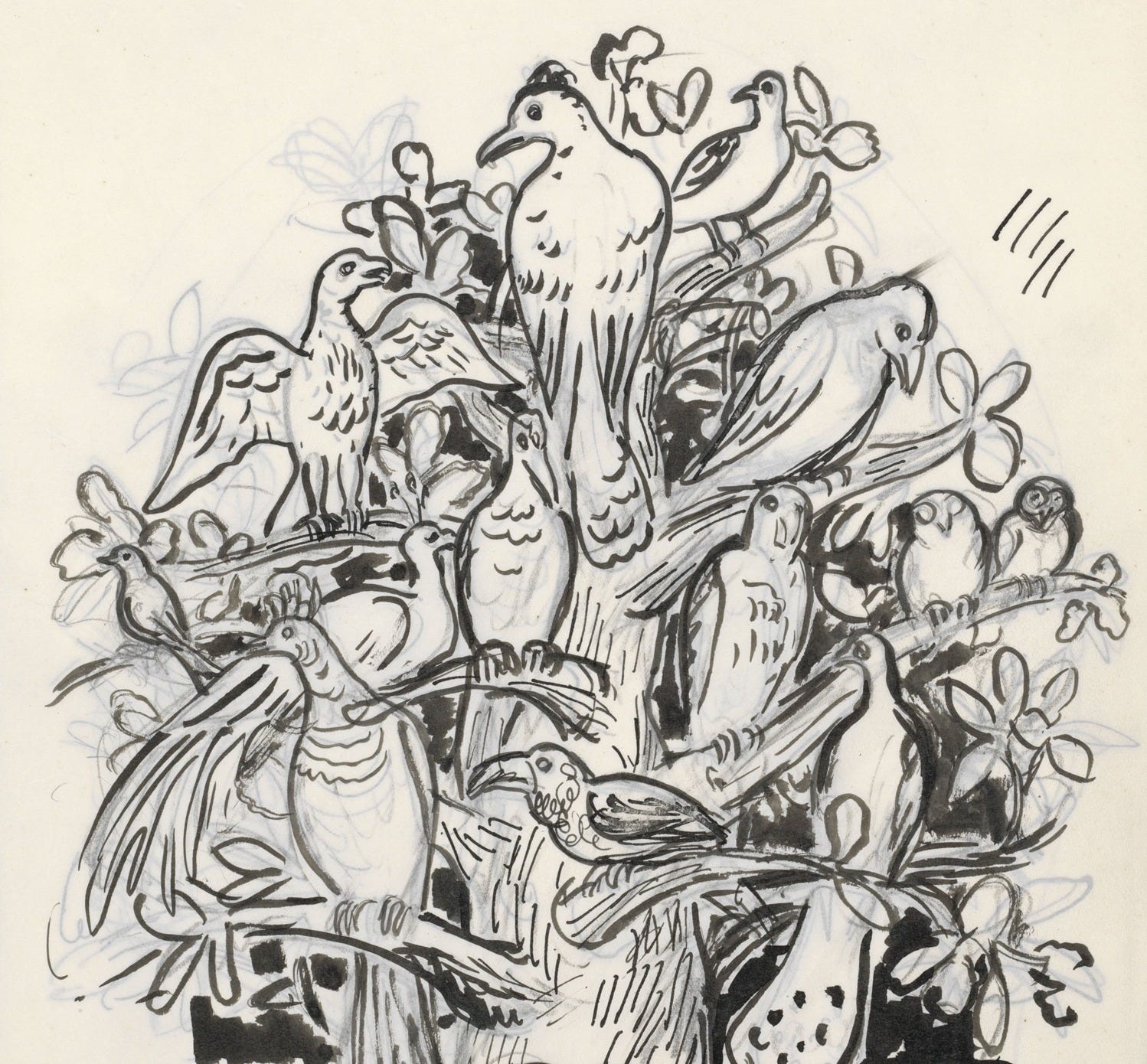
The old walls have erupted with wing; hundreds of fledgling starlings bursting forth from their stony nests and bringing clamour, chaos, calamity to the calm spring green of the garden, the weight of their plump, round-bellied bodies causing the boughs of the freshly-dressed willow to shudder and sag, the incessant calls of feed me, no me, no ME audible above the gush of the wind, audible from down the road, audible, I am almost sure, from across the ocean. And their parents, my gosh, the work they do! These round-bellied fledglings are lined up on the sighing boughs of the willow and they are calling and calling and their parents zip back and forth, back and forth, back and forth, beaks full of unfortunate creatures, and they deliver these juicy creatures to one baby or another and then they are off again, and there is a motorway, a highway of them, of all these birds with brimming beaks that become empty and then full and then empty, and watching from the window, paintbrush in my hand (because I’ve been busy at the easel but am now thoroughly distracted by all this loud and vibrant life), I wonder if these adult starlings are feeding any old baby, and how on earth could they know which baby is their own within this utter madness of fledglings. But the more I watch, the more I suspect that the adults know precisely which of these spherical, hungry darlings are their own, because they are very particular about who they feed (the babies are not so particular; they tackle any adult who comes close). And now, googling how do starling parents recognise their young, I cannot even pretend I am painting; my paintbrush is discarded on the windowsill and I’m holding binoculars in one hand and my phone in the other, scrolling google scholar, thinking of how I learned, a few weeks ago, that wild green-rumped parrotlets give a unique name to each of their babies while they are still in the nest, and repeat these names over and over until each baby knows its own name—and so, when the babies have fledged and the adults and youngsters are flying together in their flocks of up to one hundred individuals, the parents can keep track of each of their precious babies. And I am wondering if starlings do something similar. This is the information I’m looking for on google scholar as I sit by the window, a shard of sun shining onto my forearm, the cacophony of starling song shouldering its way into the room, and what I find is that we don’t know an awful lot about individual recognition in starlings (this is the biggest joy of science for me: not learning what we do know but everything we do not, how much mystery there still is in this world). But what we do know is this: starling parents recognise their own chicks, most likely through recognising their individual voices. This adds up with what I’m seeing: the adults flying to the willow, pausing, taking a moment—as if to listen—before heading to one singular mouth within the clumsy tide of gaping beaks. And what a thing, to have this fresh knowledge, to have let these birds lead me down this road to somewhere new. And this is not a piece about technology, but it does come to me, as I sit watching these starlings in the willow, how important it is to engage with the world in this way; I mean, to be still and to listen to the world, to let it take you by the hand and lead you somewhere unexpected, unplanned.
For my PhD, I watched jackdaws for thousands of hours. Just a few years later and all that watching could now be automated; a computer model fed with video footage would spit out all the data I’d need to answer the questions I set out to ask, and so I could move onto the next question, and the next, and the next, without ever actually having to invest time in watching the birds. If you’d told me this during my studies, I probably would have let out a sigh of relief and put that computer model into motion because think of all I could get done if I wasn’t spending hours and hours watching the birds, getting to know them; think of all the extra papers I could write, the lines I could add to my CV, the rungs of the ladder I might then be qualified to climb. I would be so efficient and so productive and I would barely have to look away from my screen . . . And this is what tech is doing everywhere, for everyone, isn’t it? It’s not always bad, of course—sometimes new technology is brilliant, life-improving, lifesaving—but there is no doubt that a lot of the tech being introduced into our everyday lives has been designed by people who believe the measure of a good life (a good worker’s life) is productivity, output, efficiency. Thinking within the lines. Moving as little as often. Using every spare morsel of energy for something that can be quantified, examined, bought and sold. But is this a measure we want to accept? Is this a measure we want to allow? Are technologies built to maximise these measures actually going to make our lives better?
Okay, maybe I lied, maybe this is a piece about technology after all—or, more accurately, maybe this is a piece about how muddled we have become when it comes to what we want from technology; about how we, as a society, have started to confuse the line between living a full life and living a productive one; between living a meaningful life and living an efficient one; between being a satisfied human and making someone higher up the capitalist food-chain satisfied with us. Maybe this is about how we have allowed measures of profit-potential to seep into how we value ourselves, our lives, our time.
But also, maybe this is a piece about rebellion. Everyday rebellion. Soft rebellion. A rebellion acted out in those small moments where we turn our backs on efficiency, productivity, output, and allow curiosity to draw us a map, take us by the hand and lead us wherever it might. To a poem, perhaps (the writing or the reading). Or a painting. Or a daydream. Or a new path that winds past trees we’ve never met before, towards thoughts we’ve never thought before—or, maybe, to a willow full of starlings, the boughs sagging with the weight of all those new, round-bellied bodies whose voices—if we are still, if we listen—fill the whole gaping sky.
The juvenile starling calls in the audio were recorded by David Darrell-Lambert, XC1136655.
Thank you so much to those who donated to the marine mammal rescue kit; I am thrilled (and shocked) to say we have already reached the target! This means the world; thank you thank you thank you!
If you enjoy my work, you might like to pre-order my debut novel, These Glass Bodies. (Please note if ordering from outside the UK, pre-order options may be limited but will expand closer to publication).
‘An absorbing, unmissable and moving debut novel of love, disconnected people and our fragile relationship with the natural world’
You can also support my work by becoming a free or paid subscriber, or leaving a tip. All my posts are free, and paid subscribers (thank you!) allow me to keep it this way.
If you’d like to become a founding member, you’ll receive an original watercolour painting. Currently I’m working on sea-swimming selkie women, but the odd whale is springing into life, too.
I have been thinking about this for the last couple of weeks from a different angle and in my post today -- "A rebellion acted out in those small moments where we turn our backs on efficiency, productivity, output, and allow curiosity to draw us a map," I'm on retreat having a rebellion and it has been so enlightening. How to take it back to everyday life of course is the question, but love the notion of soft rebellions.
Thrilled you raised the funds for the whale kit.
As I near the end of an average life expectancy, I'm proud and happy to say that most of my life has been spent at play--even getting paid for some of it--and that measurable productivity has been practically nonexistent. Efficiency has been almost totally absent from my life. I still waste too much time staring at screens, but opt for the real thing as often as I can. Thanks for this post. It made me feel vindicated.