

we are floating
meeting Nótt and Hulk

It is raining, round-bellied summer splotches that are slurped straight up by the soil. We wade through long grass, climb over a barbed wire fence, walk down onto rocks that slope right into the Atlantic. North of here is a great gulp of nothing, a clean stretch of sea right to the arctic. Usually this sea is a fractious thing, but tonight it is calm, lapping rather than thrashing, little dimples where round-bellied raindrops fall.
Behind us, in the long grass, stands a man with a telephoto lens. In front of us, a neighbour perches like a sparrow on the rocks, looking out to sea. About twenty grey seals are in the shallows, just where the small waves break. They are facing seaward, heads telescoping out of the water, a hum of tension in the air, in their bodies.
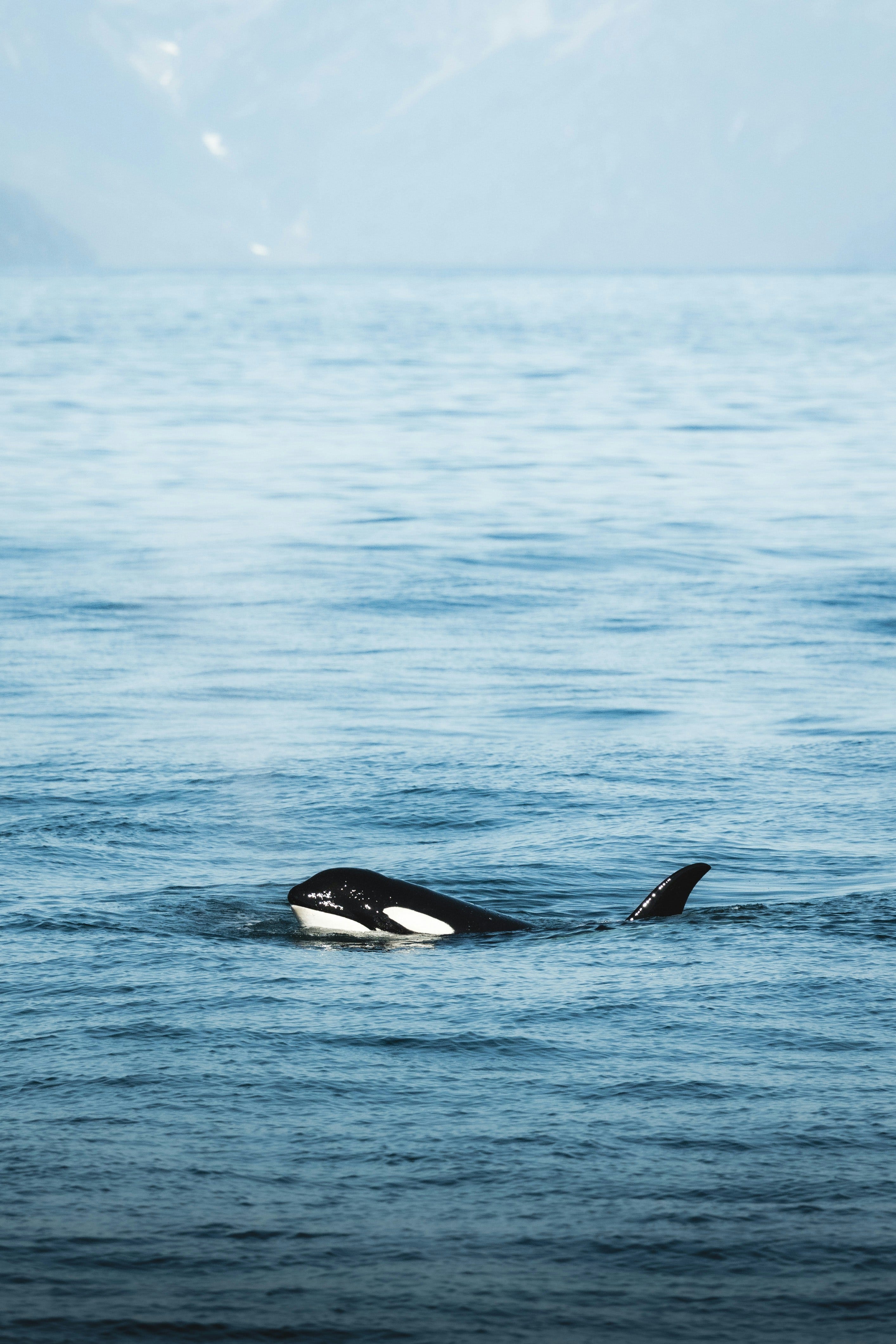
There is a hum in the air up here too; we are waiting, we are watching, until there—just ten or so metres from shore—a dorsal fin. Six foot (two metres) high, and so black it is a shock, an exclamation mark against the pastel landscape. And this male is so streamlined, so smooth in the way he moves that the water barely whispers his emergence, or his disappearance; his dorsal fin coming up, up, towering out of the grey-blue sea, and then falling back into the deep, just the faintest ripple left where the sword of his fin has sliced.
Another dorsal fin rises, the tip thrusting up and out of the water. This fin is a slightly different shape. Not quite so tall, not quite so jagged—a male, yes, but a smaller one.
The first fin rises again, so that the two are now side by side, and then the whales are still. I have never before seen still killer whales; not here, not when I saw the residents of the Pacific Northwest, not when I worked alongside the herring-hunting orcas of Iceland. But here they are, side-by-side, two males floating, surrounded by seals but with no interest in a hunt. They are just hanging out together on this rainy summer evening, bobbing their big bodies up and down in the swell of this slow, calm sea.
We watch, our neighbour, my partner and I, with hushed breaths. Every now and then a small gush of a wow or an oh escapes our mouths. But mostly the evening is quiet, embroidered only with the patter of the rain.
The boys before us are Nótt and Hulk. This is, in any case, what we have decided to call them, but they may well, like other dolphins, have names for themselves.
Hulk, probably born in the mid 1980s, used to spend all his time with his mother1. Killer whale children tend never to leave their mothers, and sons are mama’s boys—mothers treat their sons especially well, catching meals for their boisterous sons well into adulthood (daughters get no such luxury)2. So big is the impact of their mother’s preferential treatment that having a living mother greatly decreases the risk of an adult son dying. If you ever hear the rather frequent claim that orcas live in some sort of matriarchal utopia, this really isn’t true—yes, females rule the roost, but adult sons are doted on in a way that looks, through our human lens, rather unfair!
Since Hulk’s mother’s death (around 2014), he has formed a duo with Nótt. We do not know much about Nótt, only that he is younger and smaller than Hulk. Clearly, though, they are very good friends. In the last decade, one has rarely been seen without the other. The two have been spotted hunting herring off the Icelandic coast, and hunting seals as far south as Edinburgh.
Nótt and Hulk are not the only male duo to roam UK waters, though. You might have heard of John Coe and Aquarius; they are pretty famous in the world of orca nerds (I include myself in this group, as you may have guessed from the number of times I have written to you about these creatures3). They are a pair of bulls who travel the UK and Irish coastline, and who have been spotted as far south as Cornwall. John Coe is one of the oldest wild male orcas in the world; he is estimated to be over sixty-five years old.
But John Coe and Aquarius’s story is a heart-breaking one. They are the last of the UK’s only year-round resident killer whale population, the West Coast Community. The population, genetically and culturally distinct from all others, used to be much larger, but then they stopped having babies. Nobody knew why.
The last surviving female of their population, Lulu, died in 2016. That same year, I worked on her DNA for my master’s thesis and so I knew her story well: she died after getting tangled in fishing rope and suffocating. A slow and awful and agonisingly avoidable way for her to go. When scientists examined her body they found that her flesh had some of the highest levels of PCBs (a toxic manmade chemical) of any animal ever tested. She had over one hundred times the safe limit for marine mammals, and her body was considered toxic waste.
Lulu was at least twenty years old when she died, and should have been able to have a calf from the age of ten. But she never had a single one. She had never been pregnant. She was infertile because of the pollution in her body. If she had managed to give birth, her baby would have been poisoned by the high levels of PCBs that would have polluted her milk.
Other killer whales around the UK coast also have extremely high levels of PCBs in their bodies. So, the mystery of why this population stopped having babies has been solved: we, humans, poisoned them with the chemicals we carelessly pumped into our seas. And as a result, we condemned a whole population of killer whales to extinction4.
It is difficult, being a human in this world—by which I mean an engaged and curious human; a human who looks and who cares—because wherever our gaze settles, we see the wrack and ruin, the pain and destruction, we have caused.
But right now, it is impossible to let that darkness overcome this light. Because in this moment, sitting here on this rock with these two gigantic boys just metres away from me—boys who, for over a decade, have never let one another go, boys who are floating aimlessly, calmly, happily in this round-bellied summer rain—I am not thinking about Lulu.
I will think of her later—and I will think of John Coe and Aquarius, and the fact that someday soon one of them will be the very last of his kind, alone for the first time in his life, alone in the most profound sense of the word—but right now, I am not. Right now, I am sitting next to my partner and our neighbour, and we are watching these two gorgeous, glorious boys. All of us feeling the rain on our skin. All of us feeling the warmth of the evening air. All of us floating.
It is difficult, being an engaged and curious human in this world—but also, surely, it can be one of the most beautiful things, too.
If you enjoy my work, you might like to pre-order my debut novel, These Glass Bodies. (Please note if ordering from outside the UK, pre-order options may be limited but will expand closer to publication).
‘An absorbing, unmissable and moving debut novel of love, disconnected people and our fragile relationship with the natural world’
You can also support my work by becoming a free or paid subscriber, or leaving a tip. All my posts are free, and paid subscribers (thank you!) allow me to keep it this way.
If you’d like to become a founding member, you’ll receive an original watercolour painting. Currently I’m working on sea-swimming selkie women, but the odd whale is springing into life, too. I am happy to take requests!
We presume she (Defiance) was his mother, but this was never confirmed.
This was found to be the case in resident orcas in the PNW; whether or not it is the case in these killer whales, we do not know.
If you’d like to read some of my other orca pieces, here they are:
The wild has no clean lines
On orcas and anger
Klaxon for the killer whales
Velvet lips & orca gifts
A 2018 paper on PCB contamination in killer whales came to these horrifying conclusions: “Populations of Japan, Brazil, NE Pacific Bigg’s, Strait of Gibraltar, and UK are [because of PCB levels] all tending towards complete collapse”, and: “we show that PCB-mediated effects on reproduction and immune function threaten the long-term viability of >50% of the world’s killer whale populations”.
Exquisitely told, Rebecca, as always. The lull of that calm sea and ease of the orcas becomes so fragile when you reveal this to be a story about endlings. I didn't know about the fate of your orcas and of so many around the world. Whales and dolphins as toxic casks, yes, but not the scale of loss now and to come. Thank you for the image of beauty amid the loss, and for helping us to not normalize the horror of it.
Ah Rebecca, this choked me up. It can be so bittersweet at times to sink into the beauty of these moments, these acts of witnessing beauty and life, when we know the angst of the other agonizing side of it. But it is so often in the very act of pausing to witness with the greatest love and humility that we may remember what, and who, we stand for. 🩵